
Dear Friends,
The first six months of the Wiyi Yani U Thangani Institute for First Nations Gender Justice, proudly supported by the Australian National University (ANU), have been busy and rewarding. We are thrilled to share some of the key milestones and updates as we continue this collective path with all of you.
In the future, we hope to use these newsletters to additionally share events and opportunities, and gather feedback
First Institute Workshop
One of the most exciting highlights was our inaugural Institute workshop where we hosted over 80 First Nations women from across Australia. Together, these women came together to yarn, weave, paint, and create with clay, sharing their visions and ideas for the future of the Institute.
Milestone Moments: Institute Advisory Committee
Our team, including our inaugural Advisory Committee, gathered on Ngunnawal and Ngambri Country to plan for the future of the Institute. We are deeply thankful to the inspiring women leading us forward: Katja Henaway (she/her), June Riemer (she/her), Estelle Clarke (she/her), Aunty Kooncha Brown (she/her) and Shonella Tatipata (she/her- not pictured). Their wisdom and insight are invaluable as we move forward with this work.
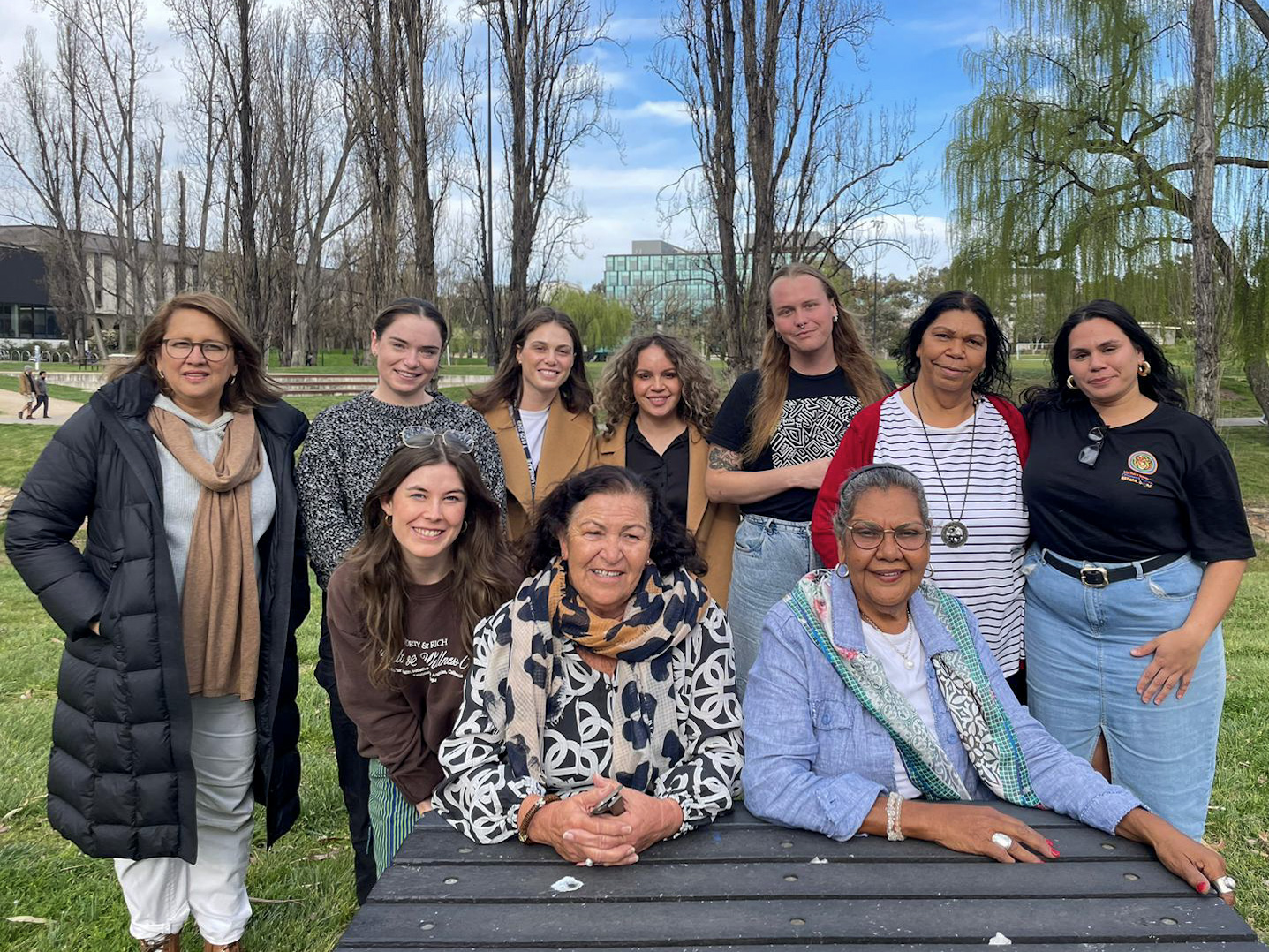
We’re excited to continue sharing the Institute’s progress and learnings with all of you, as we progress First Nations gender justice together.
Caring About Care Report Launch
We recently launched the Caring About Care Report in collaboration with researchers at Australian National University and The University of Queensland.
This research provides an understanding of the scope and nature of care work performed by First Nations women, the complex realities shaping decisions around unpaid caregiving, and the associated impacts on women and those around them.
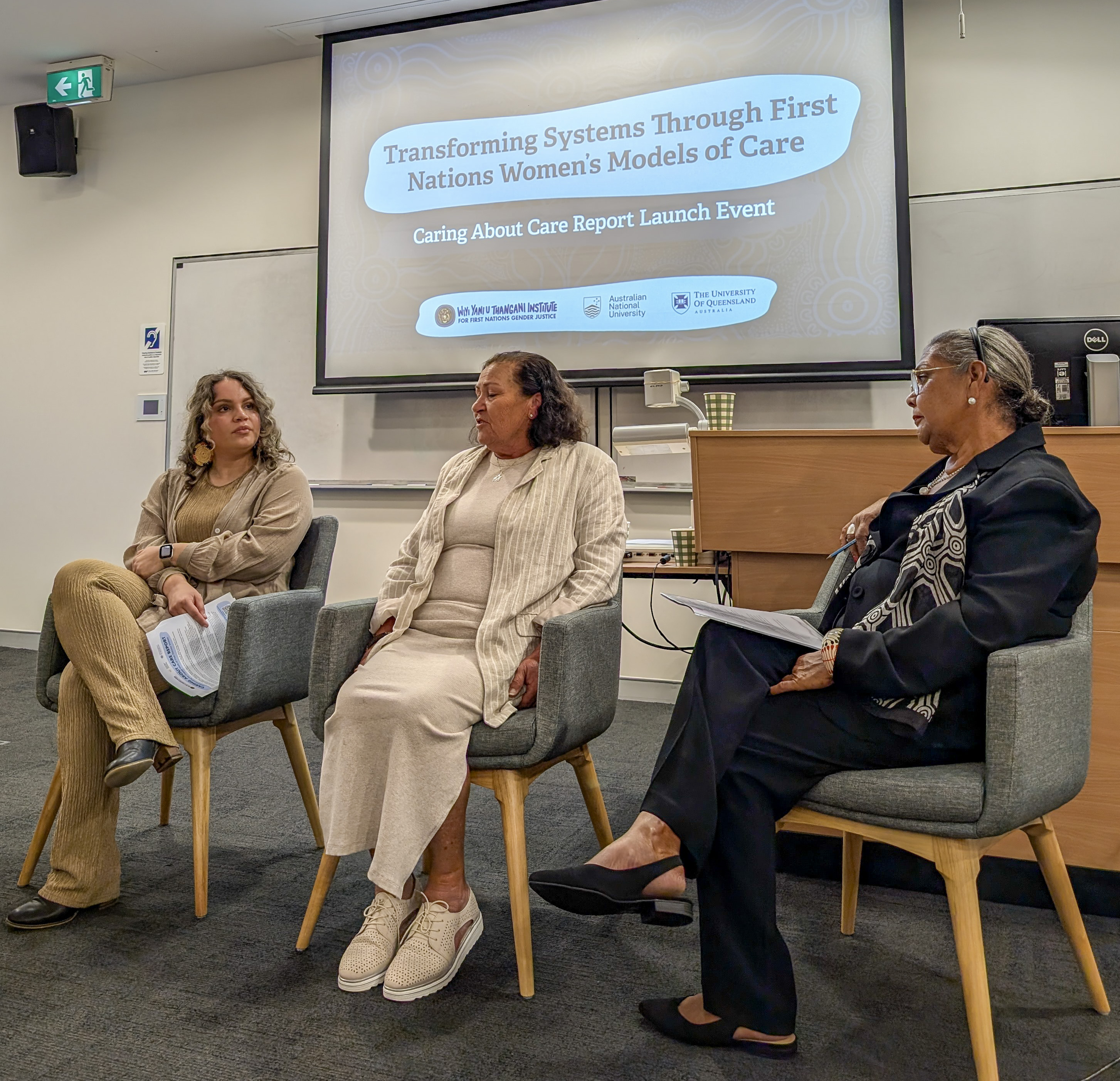
The Institute deeply acknowledges the women involved in the research and all First Nations women, girls and gender-diverse people everywhere who carry out the tireless work in keeping our families, communities and Countries safe and healthy. We also thank the researchers who led this important work - Elise Klein, Janet Hunt, Zoe Stains, Yonatan Dinku, Chay Brown, Kayla Glynn-Braun, and Mandy Yap – and the ANU Gender Institute.
Read the Caring About Care Report
International Evaluation Conference
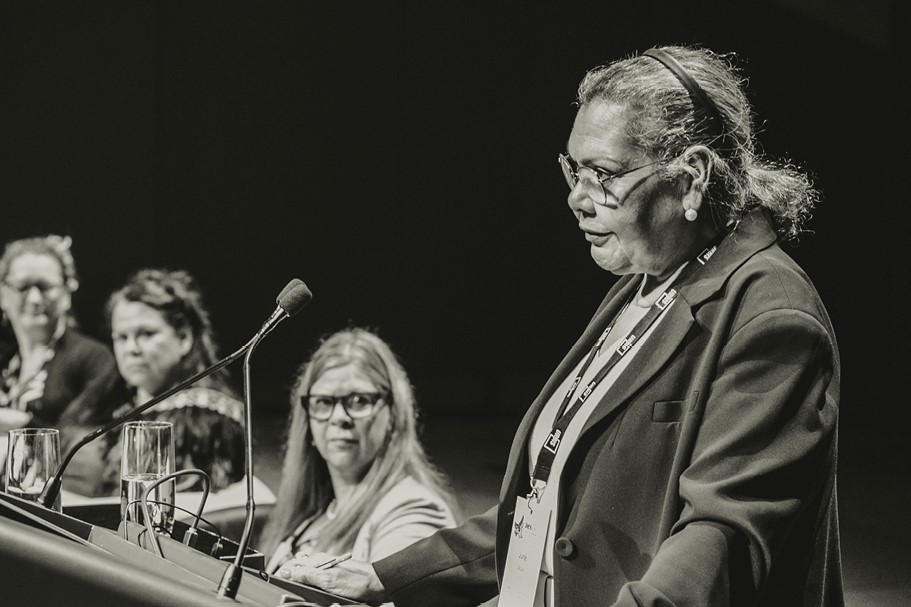
At the AES International Evaluation Conference in Naarm, June Oscar AO provided the opening keynote to over 1000 evaluators. The powerful keynote challenged those present to embrace First Nations wayfinding principles and look beyond numbers, to feelings, thoughts and wisdom.
The Wiyi Yani U Thangani team also facilitated a workshop, alongside Dr Skye Trudgett (she/her, Kowa Collaboration) and Katie Stubley (she/her, Presencing Institute). Together, participants engaged with our approach to Measurement, Evaluation, and Learning (MEL) with a First Nations gender justice lens.
This approach is purposefully distinct from Western methodologies of linear change and the traditional MEL processes that are often added as an afterthought at the end of an initiative’s lifecycle.
You can learn more about our Measurement, Evaluation and Learning approach in the Change Agenda, pages 54-63.
Centring First Nation’s Care Seminar
Hear from the researchers involved in the Caring About Care Report in the upcoming POLIS@ANU Seminar, Centring First Nations Care.
Date: Wed 13 November 2024
Time: 1 - 2:30 pm AEDT
Online: via Zoom
In-Person: RSSS Auditorium, ANU Research School of Social Sciences (RSSS)
146 Ellery Cres, Acton ACT, Ngunnawal & Ngambri Country
Come on the Journey to designing a First Nations gender justice workplace with us! As an Institute, we strive to embody First Nations gender justice principles in our workplace culture, employment conditions, policies and practices. As we develop this approach, we hope to be able to support other individuals, groups and organisations to become safe, non-discriminatory, inclusive, creative and meaningful working environments which enhance wellbeing and drive change. The way in which we are constructing this model at the Institute is by embedding into our work process, and embodying in our actions, our Ways of Working, Measurement, Evaluation and Learning approach and systems change practices.
The Ways of Working outlined in our Change Agenda are more than principles—they are living practices that guide how we foster connection, respect, and transformative action. These practices are grounded in the ancestral knowledge, cultural protocols, and lived experiences of First Nations women, girls, and gender-diverse peoples. When we connect to our ancestral knowledges and ways of doing and being, we free our minds from colonial and patriarchal thinking, embracing other perspectives, ideas and ways of living to dismantle inequalities, prejudice and individualism, and work towards collective, societal and ecological wellbeing.
Do you spend time exploring what has shaped your worldview?
How do you challenge your learnt behaviours?
Do you consider how your thoughts and actions would be different if you had someone else’s experiences?
.svg)