
Our terminology

We want to make sure that everyone feels included in the movement of First Nations Gender Justice. This means making resources accessible so that everyone knows what we talk about when we say and do different things.

Ever thought, 'what do they mean by that?'. Here is our guide to Wiyi Yani U Thangani frequently used words, concepts and names, including pronunciation on Wiyi Yani U Thangani. If there are any more words that you want explained, let us know. This is about accessibility for everyone.

Foundational concepts

Wiyi Yani U Thangani

Wiyi Yani U Thangani, pronounced as ‘we-ya-knee-oo-dun-ganni’, is in Bunuba language, translating as ‘Women’s Voices’. This is the centrepiece of the Institute reflecting that our priorities, projects and advocacy comes from the lived experiences, expertise and voices of women, girls andg ender-diverse peoples (inclusive of trans women and Sistergirls).

The Institute was named in Bunuba by our founder and chair June Oscar, a Bunuba matriarch, who began this work through the Australian Human Rights Commission as Aboriginal and Torres Strait Islander Social Justice Commission (2017-2024).

First Nations Gender Justice

First Nations Gender Justice is the full self-determination and realisation of equality and rights for First Nations women, girls and gender-diverse mob. Our approach to justice centres the lived experiences and ancestral matriarchal knowledge of First Nations women to combat harmful systems and heal from injustices and inequalities for the benefit of all society. It recognises, honours and embraces the inherent dignity and worth of all individuals, genders and abilities.

Peacebuilding

Peacebuilding is a conceptual framework that recognises that colonial trauma and structural discriminations have not been adequately addressed or resolved, which has resulted in deep and ongoing impacts on First Nations peoples and communities, perpetuating conflict across community, institutional and societal levels. We understand this externally imposed context must be transformed, knowing that reaching just and equal existences demands more than the absence of destructive conflict. It requires the building of respectful relationships, where diversity and difference are embraced as strengths that shape a shared and equitable future. Through amplifying the collective action and knowledges of women and reinforcing cycles of care, we work to reshape systems from the ground up, encouraging all people to heal divisions and create conditions for both people and the planet to thrive.

First Nations women are, and have always been, peacebuilders—navigating conflict, responding to trauma and crisis, investing in generational health and wellbeing, and leading collective efforts to challenge discriminatory structures and create enabling conditions for our children, families and communities.

Our Strategic Priorities are shaped by this understanding, and our approach to implementing them is guided by these practices of peacebuilding at every level. Together we mend and weave, repairing what is torn with colonisation and discrimination, growing vibrant movements, which connect, energise and sustain each other.

Muraga Village

Muraga Village is a nourishing, peaceful and caring living place in the central Kimberley of Western Australia. Some 90kms from Fitzroy Crossing, it is accessed from a dirt road that takes community, station workers and travellers through the deep springs, winding creeks and rocky ranges of Bunuba Country toward the dramatic Bandilngan (Windjana Gorge): the fortress-like gates to the Gibb River Road.

The Village is grounded in Bunuba culture, histories, intergenerational knowledge, surrounded by sacred sites, and the vast tracks, ceremonies and songs of the Bunuba creator beings who formed the land and all its kin. It is a visionary initiative of June Oscar AO in collaboration with the Wiyi Yani U Thangani Institute for First Nations Gender Justice, which June founded in 2024. The concept of the Village crystallised at the inaugural peacebuilding Co-Design Camp, held on the site in 2025. First Nations women, girls (inclusive of transwomen and sistergirls) and gender-diverse change-makers from across the continent experienced the collective calm and clarity of being held by Country, away from built environments, with the time and space to think deeply, restore and co-design new pathways forward.  

Now the Village continues to be formed from this gathered wisdom. It is becoming a centre of healing and respite, a place to challenge discriminatory systems and to envision and enact inclusive, healthy, prosperous and caring futures.

Muraga is the Bunuba name of the medicinal Desert Bloodwood tree, which is plentiful across the Country the Village sits on. The sap of the tree is used to heal wounds, and the Balabi (Bush Coconut), which forms on the tree as a woody growth, is a nutritious food.

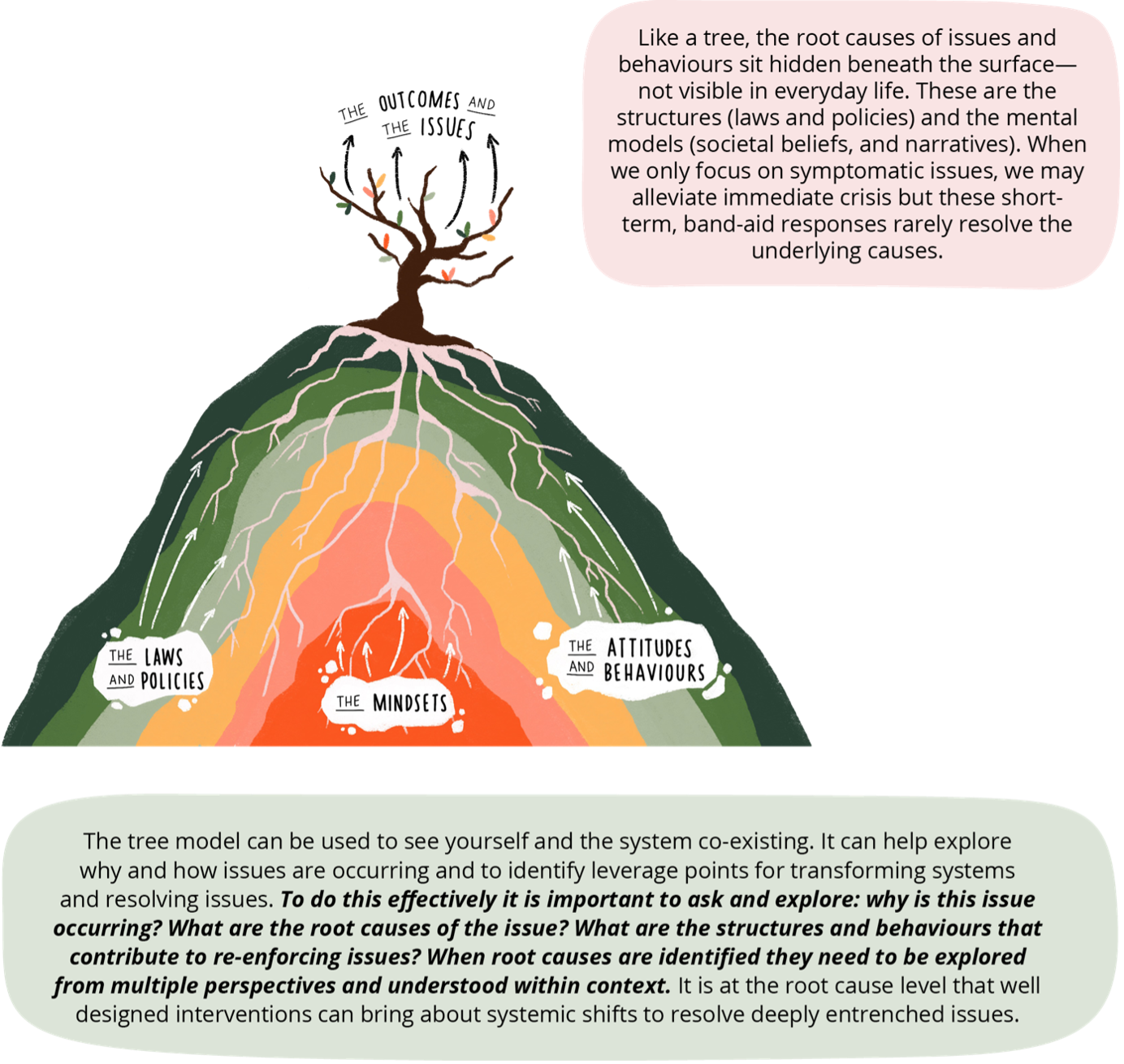
Systems Change

First Nations peoples are the oldest and most experienced systems thinkers in the world. Our societies and ways of being are generated and sustained through extensive, interconnected systems of knowledges. These knowledges teach of how to live within, care for, and adapt to the dynamic ecosystems that all of life depends upon. They show how the human and non-human form relationships and affect one another. These systems are supported by interconnected structures of Laws, protocols, kinship, and cultural practices. They contain lessons, values and principles of relationality, collaboration, intergenerational responsibility, love, collective care, inclusivity, reciprocity, life-long learning and more. All of which are the threads and elements that construct life functions.

Systems thinking may sound confusing but, in essence, it is a First Nations worldview. Still, there are many ways to define systems practices. Overall, a systems thinking and practice approach places issues in context by taking a bird’s eye view to see the bigger picture of how elements interact and create a diverse range of outcomes. Structures—laws, policies, funding arrangements, relationships and institutions, and actors—people, employees, decision-makers, the public, deliverers and recipients of services—are both fundamental aspects of how systems function. The generalised method of systems practice is non-linear, action-oriented and iterative. It encourages a process of identifying issues through exploring root causes and probing assumptions. It necessitates listening to diverse perspectives and designing initiatives based on evidence, and then trialling, evaluating and incorporating new learnings into initiatives, to constantly improve and achieve better outcomes.
Additional terms and ideas (in alphabetical order)

Care

Care is woven into the fabric of our societies as a collective value to give and receive love, kindness and support to others. It is taught to us through our cultural practices, laws and kinship responsibilities, teaching us how to share and receive knowledge, how to look after our kin and Country, raise children and look after our old people, and how to maintain peace and good forms of communication throughout communities for our collective wellbeing.

Country (capitalised)

When capitalised, Country refers to the lands, waters and skies of First Nations peoples. Country contains complex knowledge and practice systems about connection to place, language, spirituality, governance systems, culture, care, family and identity. Country is alive and connected to communities, and is both a recipient and giver of care.

“The relationship is reciprocal and relational, caring for Country and being held and carried by it, including returning to Country after disconnection and feeling accepted home. It's kinship, totems, moiety and clan, the alliances and songlines our ancestors travelled. Country is teacher, and knowledge comes through listening and observing. Running through it is the rise and return of matriarchs, and Country as spirit and centre.” (Participant on WYUT Peacebuilding Camp 2025)

Gender responsiveness

Gender responsiveness provides a lens through which to see, understand, analyse, respond and shift systems through the experiences, values, aspirations and needs of women, girls and gender-diverse peoples. It places these voices and knowledges at the forefront of decision- making, and across all stages of work, enabling systems actors to learn, respond and drive change determined by these lived realities.

Intersectionality

Intersectionality is a lens used to understand systemic and structural privilege, discrimination and inequality. It refers to how parts of our lives and identities, such as gender, race and abilities, intersect, overlap and compound to shape how we move through the world. The way in which society and our surrounding environments values or is biased by certain characteristics, shapes our wellbeing, wealth and opportunities in life. Societal values and attitudes which are negatively biased can penalise, marginalise or discriminate against those with multiple identities.

(Re) as a prefix – as in (re)learning; (re)storying

(Re) learning; storying; grounding; connecting; surfacing; shifting: When we refer to actions with ‘(re)’, we are acknowledging that we are surfacing and igniting our ancestral ways of working, knowing, being and doing that draw on our millennial-old knowledge systems. Although for many of us we are doing these things for the first time, they are within our souls, resting in our chests ready to breathe new air. Through connection and cultural transmission, we recognise how our ancestral knowledges can be applied to life today, strengthening our identities and forming sustainable existences for everyone.

(Re)Matriation

(Re)Matriation is bringing back into being a system and way of living deeply rooted in our ancestral knowledge and the practices of care and reciprocity lived by our grandmothers and ancestors. It centres on the collective wellbeing and nurturing of people and the environment as interdependent, which can be found in our matriarchal ways of being. It recognises this connection as a sacred relationship that has existed for millennia, and can provide insight and solutions for creating more equitable and just social, economic and ecological relationships.

Safety

Safety is integral to wellbeing and health. We use it as a holistic concept that requires balance, harmony and empowerment to be felt and experienced across all areas of life, beyond a physical feeling, to be sensed in cultural, spiritual, and deeply personal ways.

Systems Actors

Systems actors are the stakeholders, collaborators, communities, and individuals who exists within the systems we seek to change. Although the ability of these actors to influence change differs, everyone has a role, big or small, in contributing to enabling, caring and thriving systems for us all to live. More direction on the role of different actors in included in ‘Systems Actors: seeing yourself in our Change Agenda’.