
Dear Friends,
When Indigenous women across oceans meet and share knowledge, something powerful happens. Last month, our journey to Indonesia revealed truths that have shifted how we understand the very heart of our work — that care and sustainability are inseparable, and that the knowledge systems we carry are exactly what the world needs right now.
In this newsletter, you'll discover insights from our Knowledge Exchange Program, witness sense-making in practice as one of our Ways of Working, and learn about the South West Aboriginal Women Collective's powerful regional gathering.
We'd love to hear from you—if you have stories of First Nations women, girls and gender-diverse people doing incredible things, please let us know via wyut@anu.edu.au.
During the last two weeks of August, the Wiyi Yani U Thangani team and six First Nations women from across the continent, travelled together to Indonesia for the Institute’s Indigenous Women’s Sustainability Knowledge Exchange Program. The program focused on what sustainability means through a First Nations gender justice lens, exploring how our knowledges of caring for Country and community reflect sustainability, how our voices can influence local to global spaces making decisions for our futures, and what sustainability looks like in practice connecting with our Indonesian Indigenous sisters.
In Week One of the program, we were hosted by PEREMPUAN AMAN, our Indonesian sisters fighting for the rights of Indigenous women across Indonesia. On the first day meeting, we were warmly welcomed into their office, or rather, their home – reflecting this place as not solely a workplace, but a community space to come together, share meals, and stories. PEREMPUAN AMAN president Ibu Devi and their and networks of communities and First Nations women across Indonesia, shared stories of what it means to be Indigenous and a woman in Indonesia, stories of their fights for justice and how decades of advocacy, collective empowerment, and solidarity has changed the landscape of Indonesia in big ways and small, to strengthen their rights and wellbeing. The following day continued this conversation, bringing together AMAN, the Indigenous Peoples Organisation under which PEREMPUAN AMAN is a wing of, and women and communities online joining again from all across the country. In these conversations, we shared and reflected the many similarities of culture, history and struggles between Indigenous women in Australia and Indonesia, and stories of care and sustainability that reflected how Indigenous women have always held the knowledges and practices, and being the backbone of communities to thrive.
Together with PEREMPUAN AMAN, we spent two unforgettable days travelling to Tano Batak (North Sumatra) to visit the rural Indigenous communities of Sihaporas and Dolok Parmonangan. We shared stories, tears, belly laughs, gifts of gratitude, songs, dancing, and meals. With the aid of interpreters, we listened to women and community leaders talk about their unrelenting fight for justice against dispossession of traditional lands, disempowerment and the strength of community. It was invigorating to witness the power of community in between these stories of pain, and the importance of care in protecting each other.
We are deeply grateful to Devi and PEREMPUAN AMAN for hosting us, and sharing their communities with us. During this week, we felt a strong bond form, where, in every space we entered, we were treated as family and friends with love and safety. As one of our delegates, Zara, shared in thanking the communities we visited, “Despite not speaking the same language, I feel we speak the language of love”.

Together with PEREMPUAN AMAN, we spent two unforgettable days travelling to Tano Batak (North Sumatra) to visit the rural Indigenous communities of Sihaporas and Dolok Parmonangan. We shared stories, tears, belly laughs, gifts of gratitude, songs, dancing, and meals. With the aid of interpreters, we listened to women and community leaders talk about their unrelenting fight for justice against dispossession of traditional lands, disempowerment and the strength of community. It was invigorating to witness the power of community in between these stories of pain, and the importance of care in protecting each other.
We are deeply grateful to Devi and PEREMPUAN AMAN for hosting us, and sharing their communities with us. During this week, we felt a strong bond form, where, in every space we entered, we were treated as family and friends with love and safety. As one of our delegates, Zara, shared in thanking the communities we visited, “Despite not speaking the same language, I feel we speak the language of love”.
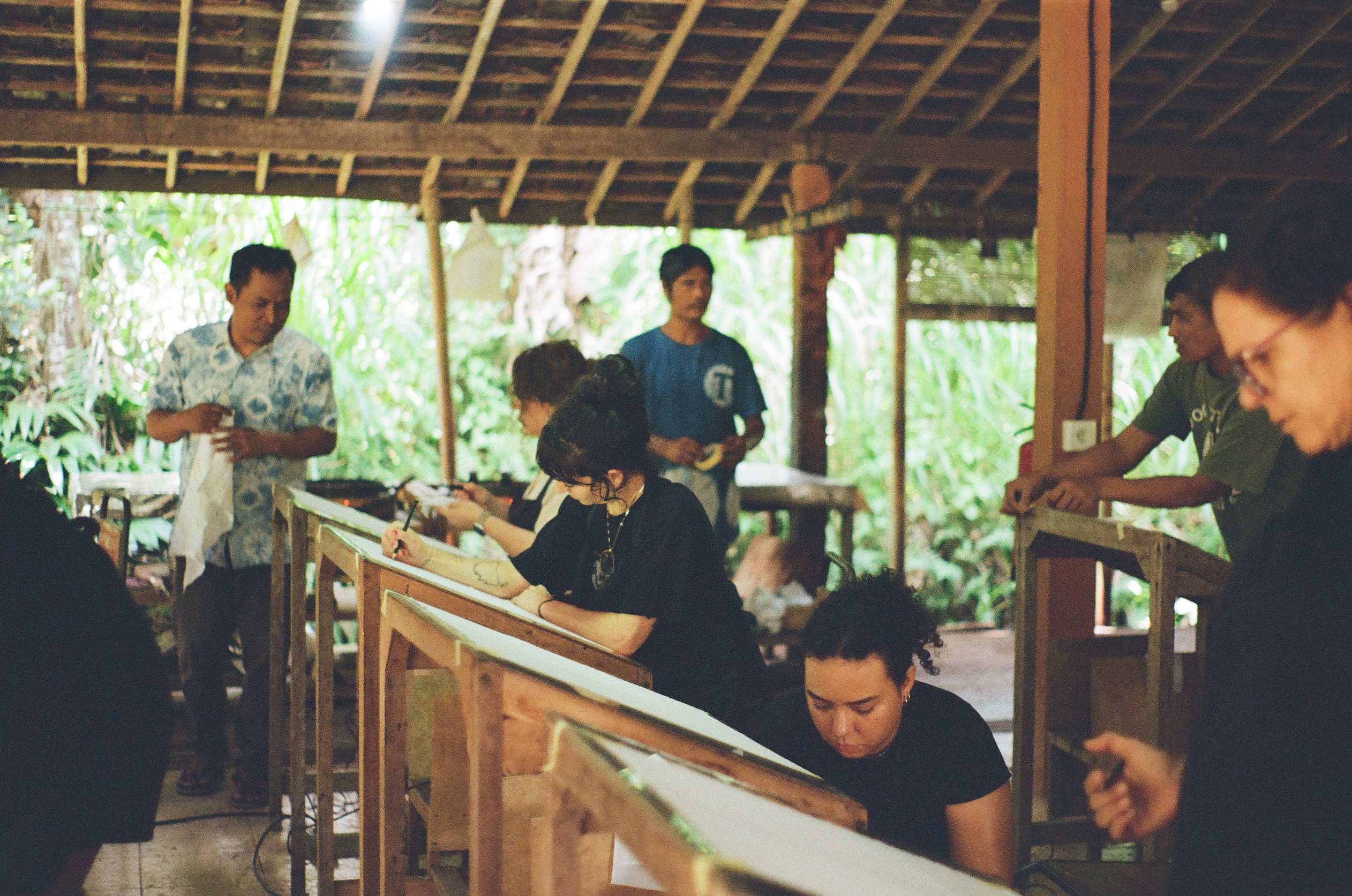
During week two of the program, we participated in a two-day workshop with Indigenous textiles organisation, Threads of Life, teaching us the sustainable and traditional practices of textiles dying. Exploring and spending quiet time in their dye garden, surrounded by green, was a relaxing and meaningful experience. Our host, Komang, explained the processes of procuring and developing each type of dye with plants from the garden, and the patterns and practices of dying cotton material. This was a seasonal journey shared from growing the dye plants, harvesting, fermenting, mixing with chemical compounds and applying to fabric. We were told about the ways in which these practices, traditionally held by women, have taken place for generations, and rely on knowledge of the environment, seasons, and types of plants. We were then given time to let our creativity flourish and experiment with this process dying cotton with patterns and colours reflecting our knowledges, stories and motifs that spoke to us.
The following two days, and our last working days in Indonesia, we hosted workshops between the delegates involving a series of yarns around questions about sustainability, visioning future systems and influencing decision-making spaces about our rights. This involved individual and group time for reflection, systems modelling, and visualisation of where our impact as delegates and an Institute lies in connecting women from local communities into global decision-making. These workshops provided valuable insight into how the program has influenced us, how it has added to our stories and learnings and the power of two-way learning, deep listening, sharing and collective action for First Nations gender justice.
The journey deepened, strengthened and reaffirmed our knowledges of sustainability and care, and how these manifest in our relationships and nurturing of family, community and Country. With what we expected could be diverse and unique learnings between Indigenous women of Indonesia and Australia, instead highlighted similarities and connection, reflecting to us that difference in language and distance does not mean separation. We reflected our need for further two-way learning and relationship building with our international Indigenous sisters to fight for our rights in solidarity. Where we see sustainability knowledges and practices being misrepresented and watered down to suit agendas that don’t reflect our values and communities., The knowledges we have held as First Nations women for time immemorial are those that need to shine. In our collective voice for rights, alongside our Indonesian and other global sisters, we will continue this journey to shape a sustainable and caring future that enables us all to thrive.
We show our deepest appreciation all those that took part in this journey with us, to Mandy Yap for supporting our relationship with PEREMPUAN AMAN, and to the Department of Foreign Affairs and Trade in funding this program.
The South West Aboriginal Women’s Collective (SWAWC) recently held its second Roundtable on Wardandi Boodja, bringing together over 100 Aboriginal women from Bunbury, Manjimup, Collie, Busselton and surrounding towns. Building on the success of the first gathering in January, the Roundtable highlighted the momentum of Aboriginal women uniting to shape a strong regional voice, inspired by the Kimberley Aboriginal Women’s Council and the Wiyi Yani U Thangani Institute.
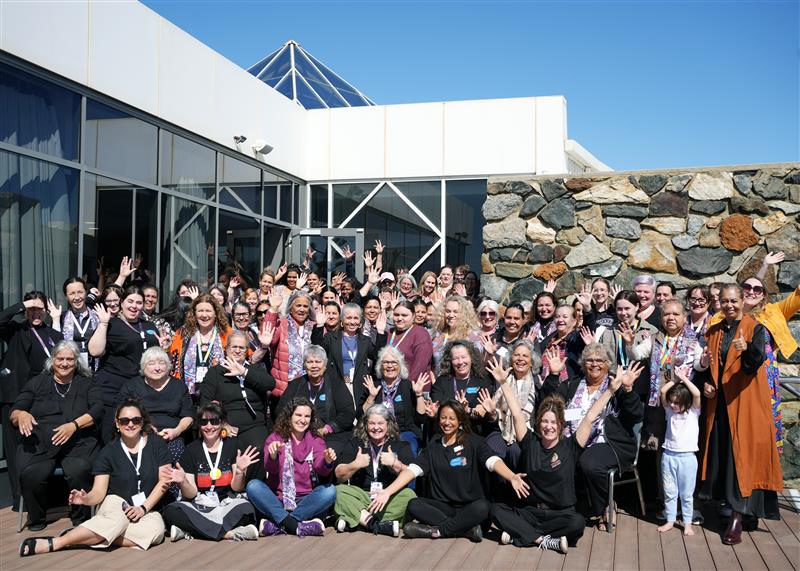
Across two powerful days, women engaged in yarning circles, leadership panels, and storytelling. Key priorities identified included the need for a new women’s refuge in the South West and equity in education funding so that girls’ school programs are resourced at the same level as boys’. As Ballardong and Badamia woman Amy Binder reflected: “The SWAWC is all about holding a space where women can come together and have their voices heard. We know we can dot his—create the change that women are looking for. Together, we can build pathways and transform systems.”
The gathering also honoured legacy through the Remarkable Aboriginal Women in the South West project, recognising trailblazers Phyllis McGuire and Gloria Khan. As Michelle Munns, daughter of Phyllis McGuire, shared: “Recognising our matriarchs and trailblazers ensures their strength and legacy continue to guide us.” With voices like these, SWAWC is growing into a powerful movement, holding space for Aboriginal women to lead, connect, and create pathways for the future.
From honouring our matriarchs to shaping new pathways, Aboriginal women are leading the way.
Come on the Journey to designing a First Nations gender justice workplace with us! As an Institute, we strive to embody First Nations gender justice principles in our workplace culture, employment conditions, policies and practices. As we develop this approach, we hope to be able to support other individuals, groups and organisations to become safe, non-discriminatory, inclusive, creative and meaningful working environments which enhance wellbeing and drive change. The way in which we are constructing this model at the Institute is by embedding into our work process, and embodying in our actions, our Ways of Working, Measurement, Evaluation and Learning approach and systems change practices.
The Ways of Working outlined in our Change Agenda are more than principles—they are living practices that guide how we foster connection, respect, and transformative action. These practices are grounded in the ancestral knowledge, cultural protocols, and lived experiences of First Nations women, girls, and gender-diverse peoples. When we connect to our ancestral knowledges and ways of doing and being, we free our minds from colonial and patriarchal thinking, embracing other perspectives, ideas and ways of living to dismantle inequalities, prejudice and individualism, and work towards collective, societal and ecological wellbeing.
This month, we want to share how sense-making guided our Knowledge Exchange Program in Indonesia. Sense-making is about engaging our whole being — not just our minds, but our hearts, spirits, and bodies — in connecting with the world around us.
Throughout the Knowledge Exchange Program, we practised leading from our heart space, drawing on the energies surrounding us, and listening to the voices of our ancestors, the land, waterways, and the deep wisdom of Indonesian Indigenous women we met. This wasn't tourism or tick-box consultation — it was serious systems practice that allowed profound insights to emerge.
As one team member reflected: "Opening hearts is difficult. We are told to lead with our head, to focus on data and outputs. But the most powerful moments came from story-sharing and heart-opening—not from extracting information."
Through sense-making, we came to understand the values, needs and lived realities of Indigenous women across both countries. We witnessed how gender and Indigenous-led initiatives intersect with sustainability and climate justice. We learned to pause, to feel, to sense what Country and community were telling us — and to let that guide what comes next.
This practice reminds us: if we just sit in meetings answering questions the Western way, we don't access deep knowing. We don't let futures emerge. We don't hear our ancestors. Sense-making creates the conditions for transformation.
.svg)