
Newsletter - December 2025

December 2025

The Institute's monthly newsletter, archived online

Dear Friends,

As summer arrives and we close out 2025, we're reflecting on a year of deep connection, learning and building. From gatherings on Bunuba Country to international exchanges, this year has shown what becomes possible when First Nations women are resourced to lead.

We're thrilled to launch the Co-Design Camp video, created in partnership with Big hART and much more below.

In partnership with Big hART: Co-Design Camp Video Launch

We're thrilled to share the video from our inaugural Co-Design Camp on Bunuba Country. Created with Big hART through their Punkaliyarra process, this film captures what happened when more than 50 First Nations, and non-First Nations women and girls gathered in July to explore peacebuilding and how to support women's movements continent-wide.

Over four days on Country, participants yarned, created, swam in sacred springs and explored deep questions: What does peacebuilding mean to us? How do we build a national Institute to support women's movements? How do we record and revitalise knowledge to support social change?

Country held everyone. Women spoke of peace, of cups being filled, of ancient knowledges resurfacing. Young girls from Visual Dreaming's Butterfly Dreaming program joined Elders around the campfire. Networks strengthened. Tools for the collective medicine bag emerged.
Institute Updates

Reflections from France: Dance, (Re)Matriation & Peacebuilding

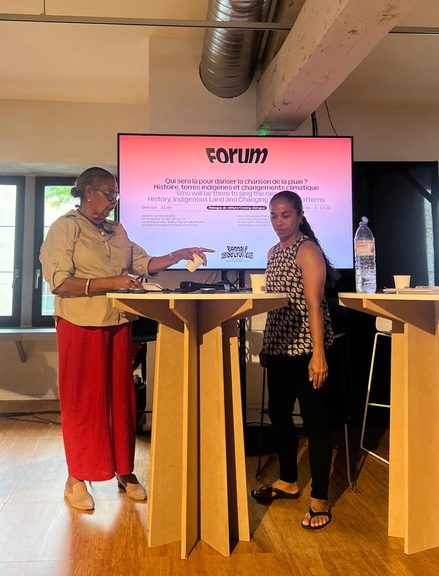
Two women stand at tall wooden tables during a forum event held indoors. One woman on the left wears a light beige shirt and red pants, looking down at papers on the table. The woman on the right wears a black-and-white patterned sleeveless top and dark pants, looking toward the camera. Behind them is a large screen displaying text in French about a forum on Indigenous knowledge, climate change, and history. The room has wooden floors, large windows, and exposed ceiling ducts.

In October, June Oscar AO, Institute Chair, and Jane Pedersen, Institute Co-Lead, attended the Lyon Dance Biennale, where Indigenous dance groups from around the world came together to explore colonisation, healing and collective wellbeing through movement.

The experience reinforced how powerful Indigenous performance practices are as forms of peacebuilding. Watching groups use body, voice and movement to tell stories about past, present and future—it was systems thinking brought to life.

Marrugeku, the intercultural dance company from Australia, demonstrated how cultural protocols around respect and reciprocity naturally create the conditions for peacebuilding. Their approach to holding space for diverse Indigenous groups offered insights that will inform how we continue developing our own peacebuilding methodology.

It was a reminder that the work of transformation happens in many forms—not just in policy spaces or research, but through art, ceremony, movement and cultural practice. All of it is connected.
Learn more about Marrugeku

Women Deliver 2026: Expression of Interest Coming Soon

The Women Deliver 2026 Conference will take place 27-30 April in Narrm (Melbourne). The theme is Change Calls Us Here. This is a historic moment—the first time Women Deliver will be regionally hosted in the Oceanic Pacific, and a chance for First Nations women to connect with global movements for gender justice.

We'll be releasing an Expression of Interest for sponsored positions for First Nations women, gender-diverse mob (aged 12+), and girls aged 12-17. Sponsored positions will include support required including conference registration, flights, accommodation and more.

Watch this space—the EOI will be coming soon.

Learn more about Women Deliver 2026 Conference
Connect with us on Facebook

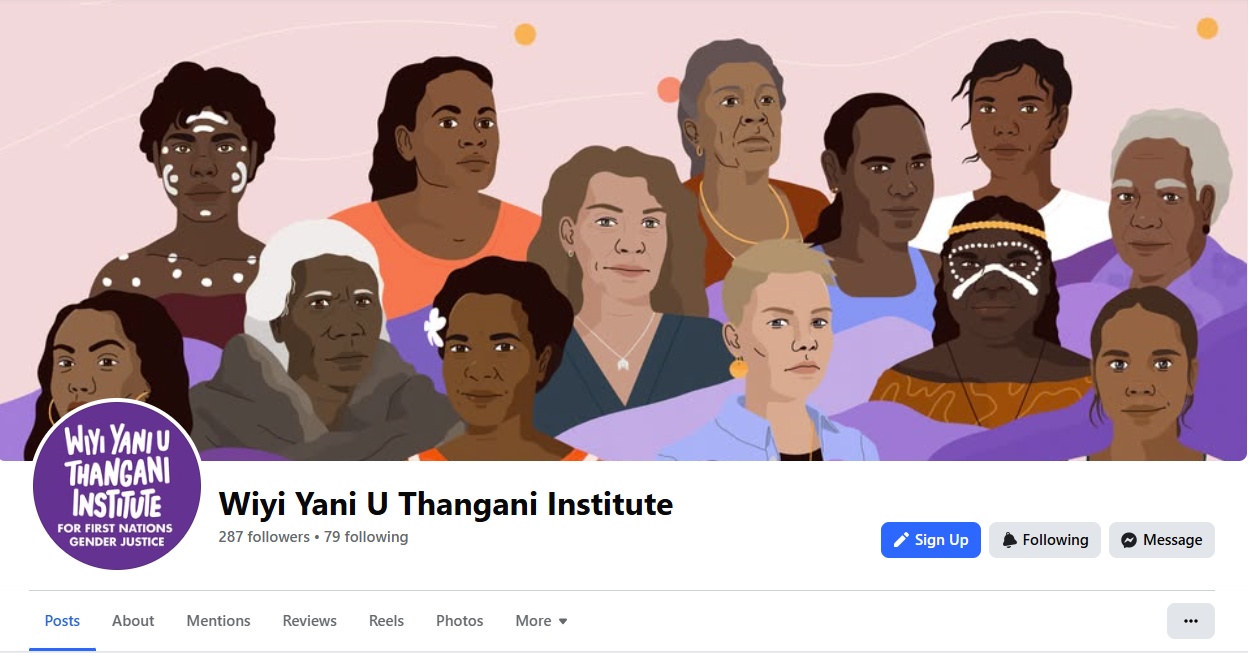
A screenshot of the Institute's Facebook page header.

We've launched our Facebook page—follow us for updates, event announcements, and community stories.

You can also find us on LinkedIn and Instagram.
Your Stories:

Visual Dreaming

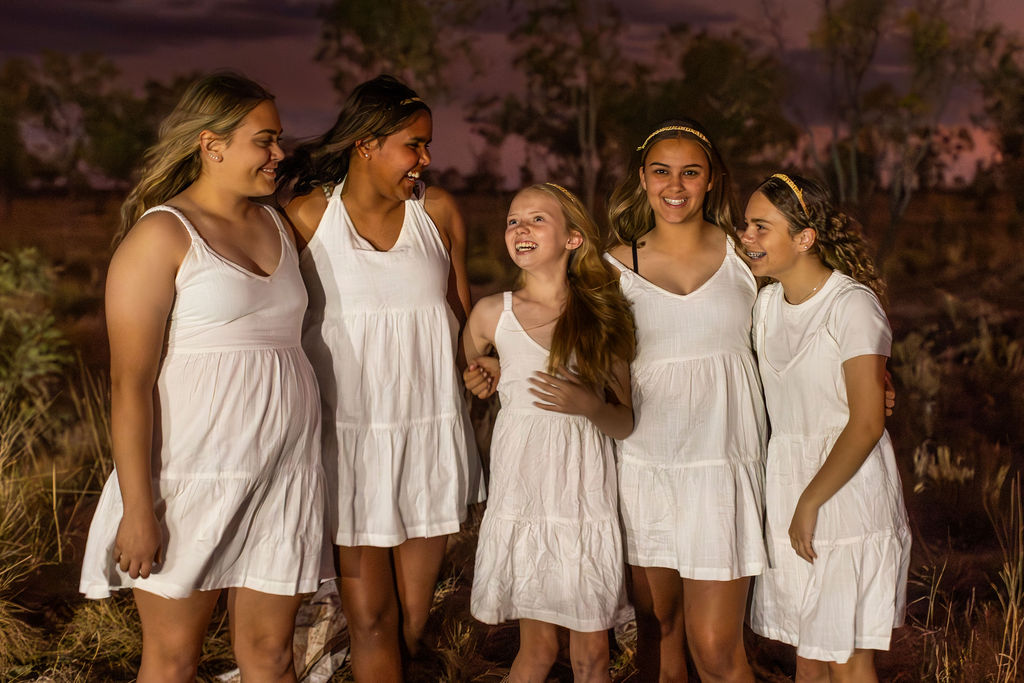
Teenage Aboriginal girls smiling at each other, wearing white dresses. They are standing in bush, at sunset.

Visual Dreaming brings together Elders, community members and young people in programs that centre cultural strength and leadership. Their flagship youth programs—Butterfly Dreaming for young women and Maliyan Dreaming for young men—take participants on transformation journeys based on the life cycles of butterflies and eagles.

Small groups of young people work with Elders and First Nations mentors, building relationships across generations while developing leadership skills. As they progress through the program, they become mentors themselves for the next cohort coming through, creating an ongoing cycle of cultural transmission and leadership.

When Leanne brought young women from Butterfly Dreaming to the Co-Design Camp on Bunuba Country, something powerful happened. These young women stepped into a gathering of First Nations women leaders from across the continent. The transformation was visible—by the end of those four days, they were speaking up, sharing their stories, holding their own space.

"I've learnt how to be more confident and comfortable around these people," one young woman shared.

Another spoke about "…hearing their stories. Learning what they've done to come here and how much they've sacrificed for their kids."

This is the ripple effect of Visual Dreaming's work—young people walking into spaces knowing they belong, carrying cultural strength with them.

Learn more about Visual Dreaming

Spending time with our Ways of Working

Come on the Journey to designing a First Nations gender justice workplace with us! As an Institute, we strive to embody First Nations gender justice principles in our workplace culture, employment conditions, policies and practices. As we develop this approach, we hope to be able to support other individuals, groups and organisations to become safe, non-discriminatory, inclusive, creative and meaningful working environments which enhance wellbeing and drive change. The way in which we are constructing this model at the Institute is by embedding into our work process, and embodying in our actions, our Ways of Working, Measurement, Evaluation and Learning approach and systems change practices.

The Ways of Working outlined in our Change Agenda are more than principles—they are living practices that guide how we foster connection, respect, and transformative action. These practices are grounded in the ancestral knowledge, cultural protocols, and lived experiences of First Nations women, girls, and gender-diverse peoples.

Impact Opportunties

We are highlighting opportunities across Australia for First Nations women, girls and gender-diverse mob to engage a variety of opportunities to amplify their voices. If you know of more opportunities available, please share them with us so we can highlight them in our next newsletter. You can also find opportunities posts on our Instagram and LinkedIn.

Please note: These opportunities are not affiliated with the Institute. We are highlighting them in an independent capacity.
YURLU | COUNTRY – Film Screening

Cinemas across Australia

Don't miss this powerful documentary about Banjima Elder Maitland Parker's fight to heal his Country—the largest contaminated site in the Southern Hemisphere.

Content warning: This film references someone who has passed away.

Directed by Walkley Award-winning filmmaker Yaara Bou Melhem and co-created with Banjima Elder Maitland Parker, YURLU | COUNTRY follows Maitland's final year as he fights to heal his ancestral lands, scarred by millions of tonnes of waste laced with deadly asbestos fibres from the Wittenoom mines.

This largely unknown toxic legacy has been on Banjima lands for more than 60 years and the contamination is spreading. Aboriginal communities in Western Australia suffer the highest mesothelioma death rates in the world. Every Banjima family has been touched by this tragedy.

This deeply moving film is more than a documentary—it's a call to action. Banjima people have launched a campaign for change to #CleanUpWittenoom and are asking everyone to #WalkWithBanjima.

Now showing in cinemas for a limited time

Board Governance Scholarship for PBC and Indigenous Community Organisations | WA & SA

The Australian Institute of Company Directors (AICD) is offering scholarships for First Nations Executives and new Board Directors to access governance training.The program includes:

  • AICD's Governance Foundations for Not-for-Profit Directors course (1.5 days) covering duties and responsibilities, strategy and risk, and finance
  • Half-day leadership workshop with JY Australia focused on community and cultural values
  • Travel costs, accommodation and meals covered
  • Virtual coaching sessions on values, board relationships, strategic planning and financials
  • Access to AICD's First Nations Community of Practice (quarterly sessions)

Courses run in Perth and Adelaide between February and May 2026. Up to 210 places available.

When: February and May 2026

Applications close: Sunday 4 January 2026 at midnight AWST

National Indigenous Innovation Challenge | National

Got a community challenge you're passionate about solving? Pitch it to the National Indigenous Innovation Challenge and access world-leading expertise and funding to help develop solutions.

Indigenous organisations and groups can pitch community-identified challenges and lead the development of solutions, backed by interdisciplinary expertise in Science, Business, Economics and IT from Monash University.

EOIs close: 1 February 2026

UN Global Indigenous Youth Forum | National

Indigenous Youth aged 18-30 are invited to apply for the III Session of the UN Global Indigenous Youth Forum (UNGIYF)—the only high-level forum in the UN dedicated to Indigenous Youth.

Co-hosted by the Global Indigenous Youth Caucus and FAO, this biennial forum brings together Indigenous Youth leaders working on Indigenous Peoples' food and knowledge systems, biodiversity conservation, ecosystem restoration and climate change resilience.

UNGIYF 2026 will advance the policy recommendations from the 2023 Indigenous Youth Rome Declaration and connect Indigenous Youth leaders collaborating around global milestones. This gathering will shape the future of Indigenous Peoples' food systems, biodiversity conservation, climate action and land restoration from Indigenous Youth perspectives.

When: Second half of 2026

Age: 18-30 years old