
Dear Friends,
As we move deeper into the year, we've been reflecting on the power of gathering and the connections that sustain our work for First Nations gender justice. This month has been rich with learning—from our transformative camp on Bunuba Country to witnessing community-led change happening across the continent.
In this newsletter, you'll read about our inaugural Co-Design Camp, see our Ways of Working in practice, and the community-led initiative, the Fitzroy Crossing Night Place. We've also highlighted valuable opportunities for First Nations women, girls and gender-diverse mob across Australia.
We'd love to hear from you—if you have stories of First Nations women, girls and gender-diverse people doing incredible things, please let us know via wyut@anu.edu.au.
In July, over 50 First Nations women and non-Indigenous collaborators came together on Bunuba Country for the inaugural Wiyi Yani U Thangani Co-Design Camp. Hosted by June Oscar AO, the Camp was an opportunity to gather, connect and embark on a focused exploration of peacebuilding and how to support and connect First Nations women's movements continent-wide.
Over five days, participants engaged in a program of activities, combining systems design workshops and immersive experiences on Country with healing and creative practices. The program focused around our collective enquiry:
Guided by the overarching themes of matriarchal strength and intergenerational knowledge, we explored how our inner knowing and centuries of wisdom offer us practices and processes that can shape liveable and thriving systems. As we examined what peacebuilding means in our contexts, we discovered that this deep relational work generates the kind of evidence that can truly guide systems change.
The Camp revealed that when we work from this place of knowing, new tools naturally emerge for our collective medicine bag—practices and approaches that can only arise from being together in this sacred way, reminding us that the most powerful work happens through relationships, time and trust, with Country holding and guiding us throughout.
We were also joined by BighART and a collective of artists to share and capture stories of matriarchal power and practice through Punkaliyarra. We look forward to sharing what was captured at the Camp with you all soon.
The Camp marks the beginning of the Institute’s staged approach to create a national infrastructure that supports women's leadership, exchanges knowledge, coordinates efforts, and builds evidence of how to drive systemic change through a peacebuilding approach.
As part of this journey, we welcome any opportunity to connect and support your First Nations women-led movements. If you would like to share your work, dialogues and practices in driving systems change, please reach out to our team.
The Fitzroy Crossing Night Place demonstrates how Aboriginal community leadership creates lasting change through care-centred approaches that strengthen our young people and communities.
Since opening on 2 September 2024, this Marra Worra Worra Aboriginal Corporation program has welcomed 520 children across 10,000 visits, serving more than 16,000 hot meals in the remote Kimberley town.
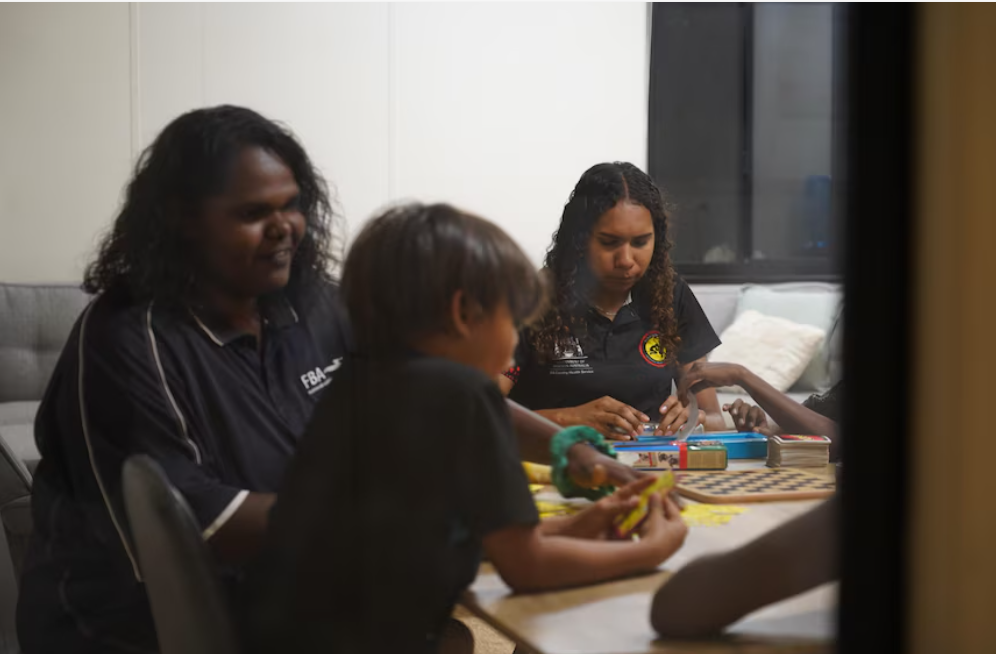
Born from years of night patrols and community listening, the Night Place responds to complex realities with care rather than punishment. “They want to be with their friends and sometimes home life is not good… they’d rather be in a place where they feel safe,” explains Youth Connection Programs Manager, Rochelle Dolby.
This transformation speaks for itself: a 73 per cent drop in car thefts, significant crime reductions, and over 100 students reconnecting with education, including 31 new enrolments. Local mum and youth mentor Edith Cox captures the essence: “They feel more comfortable… (the kids) see us around town and in here.”
The Night Place proves that when we centre care and community expertise, sustainable change follows naturally.
Come on the Journey to designing a First Nations gender justice workplace with us! As an Institute, we strive to embody First Nations gender justice principles in our workplace culture, employment conditions, policies and practices. As we develop this approach, we hope to be able to support other individuals, groups and organisations to become safe, non-discriminatory, inclusive, creative and meaningful working environments which enhance wellbeing and drive change. The way in which we are constructing this model at the Institute is by embedding into our work process, and embodying in our actions, our Ways of Working, Measurement, Evaluation and Learning approach and systems change practices.
The Ways of Working outlined in our Change Agenda are more than principles—they are living practices that guide how we foster connection, respect, and transformative action. These practices are grounded in the ancestral knowledge, cultural protocols, and lived experiences of First Nations women, girls, and gender-diverse peoples. When we connect to our ancestral knowledges and ways of doing and being, we free our minds from colonial and patriarchal thinking, embracing other perspectives, ideas and ways of living to dismantle inequalities, prejudice and individualism, and work towards collective, societal and ecological wellbeing.
Our Ways of Working come alive through practice. At the Co-Design Camp on Bunuba Country, our team discovered what happens when we genuinely let go of how we think things should be done.
As Chloe Wegener (she/her), Project Coordinator for Knowledge Translation and Design, reflects: “I thought I understood co-design, but what emerged completely shifted my perspective. It showed me what becomes possible when we stop forcing colonial structures and allow Country to lead."
This is what (re)learning looks like in action. For any workplace, it means building in time for reflection and connection to place. It means pausing before defaulting to familiar processes and asking: what would emerge if we approached this differently? When we create space for other ways of knowing, whether through connection to Country, community wisdom, or simply slowing down, deeper knowledge surfaces.
.svg)